


SSE’s Republic of Ireland Gender Pay Gap 2026
Our commitments to fair work & inclusion
We are committed to fair work and to building a diverse and inclusive workforce that reflects the community. We are a Real Living Wage employer, and from 2026, we will be rolling Living Wage out through our supply chain in Ireland too. We continue to support our Business in the Community Ireland Elevate Pledge to build a representative and inclusive workplace, since being a founding member in 2021.
2026 marks our 5th year of reporting the Republic of Ireland (ROI) gender pay gap under the Irish Government’s methodology. Previous reports (including the most recent UK gender pay gap report), and further details on how pay gaps are defined and calculated for our UK and Ireland businesses are available on our website, on the Inclusion and Diversity section and the Sustainability section.
Our ROI workforce1
We employ colleagues across technical, operational, and professional roles. The range of roles and workforce demographics influences our pay gap outcomes.
Our key business areas include:
Business Area | Description | Relevant Employees1 |
SSE Renewables | Drives the net zero transition through the development, financing, construction and operation of world class renewables in domestic and selected international markets. It also operates and develops pumped hydro storage that provides flexible and dispatchable electricity needed for a smooth transition to net zero. | 169 |
SSE Thermal | Provides critical flexibility to offset renewables variability as the energy system transitions to net zero. The strategic importance of its Gas Storage assets has been highlighted by recent world events and the increasing focus on national energy self-sufficiency. | 88 |
Energy Customer Solutions | Responds to the energy transition as a route to market for our low carbon energy generation and through the provision of a suite of energy solutions to customers. | 468 |
SSE Corporate / Other | Provides HR, legal, finance, IT, procurement, and other services. | 223 |
More information about our organisation is available on our website on our About us page.
2026 ROI gender pay gap2
In 2025/26, both the mean and median gender pay gap have seen a year-on-year increase. The median gender pay gap increased from 20.9% in 2025 to 23.9% in 2026, while the mean gender pay gap increased from 15.8% to 17.0% over the same period.
Small shifts in the gender pay gap from year to year are to be anticipated and can be driven by a number of factors. Changes that impacted the gender pay gap in Ireland this year include the following:
External hiring and workforce composition
Changes in workforce composition over the year are inevitable and have influenced gender representation across the organisation. The 2025 efficiency programme has shaped some of these changes. More information on the efficiency-related organisational restructures referenced here can be found in our 2026 Annual Report and Sustainability Report.
Recruitment activity increased by 11% between June 2025 and June 2026, however, a high proportion of new hires were junior roles. As a result, there were fewer opportunities to continue our efforts to improve gender representation at more senior levels, which has historically been an important factor in reducing the gender pay gap.
Internal mobility
We remain committed to creating opportunities for career progression across our workforce. During the year, women represented 36.5% of internal moves and promotions. In addition, our external recruitment activity has strengthened the pipeline of female talent, particularly in junior roles. Women also accounted for the majority of promotions at lower grades, supporting increased representation in more senior and higher-paid positions over time.
Recruitment into the Leadership Group
Leadership Group recruitment remained limited during the year, with the number of hires into this population reducing compared with last year. The gender composition of appointments at this level can have a notable impact on the overall gender pay gap. The lower number of vacancies also reduced opportunities to increase female representation within the most senior and highest-paid roles.
Leavers across ROI
Overall headcount has reduced over the past year from 979 in 2025 to 948 in 2026, after a period of growth. A greater number of women than men left senior and leadership positions through the same period, with a 4% drop in the percentage of females, resulting in 80 women occupying the upper middle quartile.
Long-term progress
While pay gaps can fluctuate from year to year, the long-term trend remains broadly positive.
Since 2021/22, we have made progress in reducing our gender pay gap, with our median pay gap reducing from 26% to 23.9% in 2025/26.
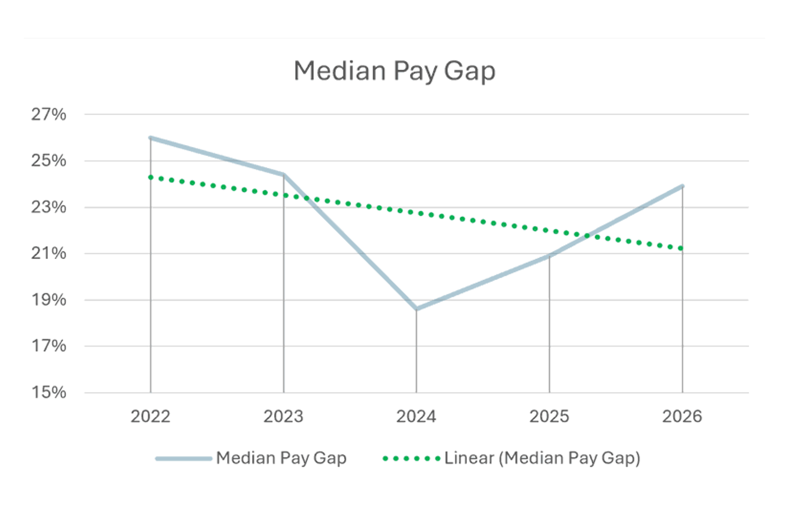
This positive long-term trend reflects ongoing action to improve gender balance. We remain focused on increasing representation and supporting progression for women. This commitment sits alongside our wider approach to workforce planning, skills development, STEM initiatives, and internal mobility and is supported by our Inclusion & Diversity Strategy, designed to deliver sustained change over time.
ROI gender bonus gap
The mean gender bonus gap has decreased from 44.5% in 2025 to 41.9% in 2026, and the median has moved from 34.5% to 40.5%.
Bonus and levels of payment at SSE are typically aligned to role size in the organisation and the gender bonus gap reflects lower representation of women at the most senior levels of the workforce. Due to the number of variables involved in bonus payments, some year-on-year movement in the mean and median gender bonus gaps is to be expected.
Looking ahead
We’ve made good progress reducing pay gaps over time. Structural factors continue to influence the pay gap, including:
Lower female representation in senior roles
Structure of our business in ROI, where around half of roles are in our Energy Customer Services business, which has a higher representation of women in more junior call centre roles.
Across our Ireland and UK businesses, we will focus on sustained, long-term actions:
Increasing women’s representation in senior and critical roles
Supporting progression and retention
Embedding inclusive policies and flexible working
Strengthening an inclusive workplace culture
You can read more in our Gender and Ethnicity Action Plan.
[1] Data includes those employed by SSE in Ireland on 1 June 2026. This totals 979 employees, 948 of which are included as relevant employees in the gender pay gap calculation. A relevant employee is determined by a number of factors and follows the Irish Government’s gender pay gap reporting methodology. This table shows the number of employees in SSE’s operational Business Units and Corporate centre and does not reflect the number of people employed under specific legal entities.
[2] Gender information is captured from legal documentation at employee onboarding and recorded in SSE’s HR data system, which maintains a 100% completion rate.